6 min read
Scroll to Explore
An interview with Karthik Venkatapathy, Team Lead – Fleet Supervision (TOMS) & Vehicle Control (FORCES) at 2getthere
When people think about autonomous mobility, they usually focus on the vehicle itself. Cameras, sensors and software work together to detect obstacles, navigate routes and make driving decisions in milliseconds.
But according to Karthik Venkatapathy, that’s only half the story.
“The vehicle may know how to drive itself, but once you have dozens or even hundreds of autonomous vehicles operating simultaneously, a completely different challenge emerges. That’s where fleet management comes in.”
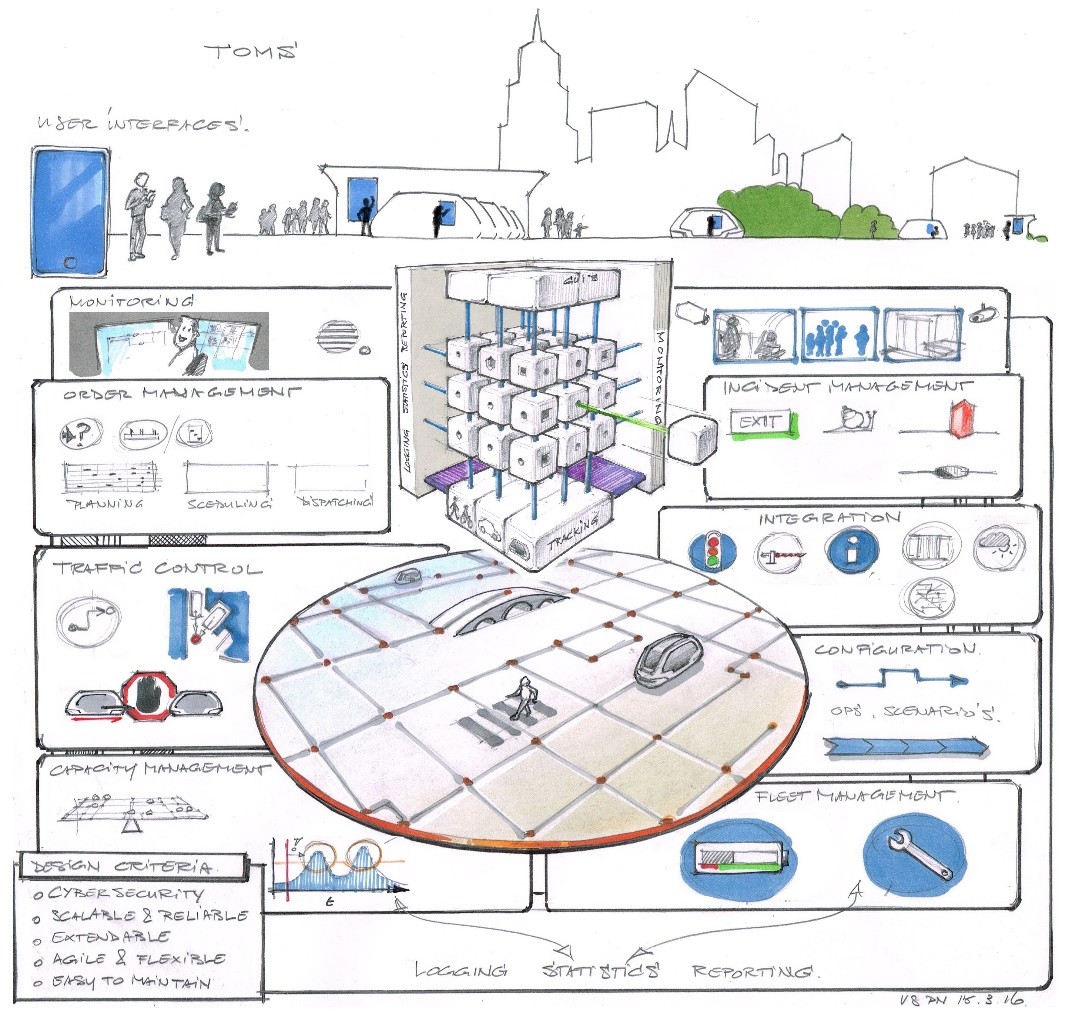
As Team Lead for TOMS (Transit Operations and Management System), 2getthere’s fleet management platform, Karthik works on the software that keeps autonomous transport networks running smoothly. While each vehicle can safely navigate on its own, TOMS continuously coordinates the entire fleet, making thousands of decisions behind the scenes that passengers rarely notice, but depend on every day.
Beyond traditional fleet management
Fleet management is often associated with dispatching vehicles and monitoring schedules. In autonomous mobility, however, its role is fundamentally different.
“In a traditional public transport system, operators constantly monitor drivers and vehicle movements. In an autonomous system, the software performs those tasks automatically. The operator only needs to intervene when something unexpected happens.”
TOMS continuously monitors the operation, allocating vehicles where demand is highest, planning routes, preventing deadlocks, rerouting vehicles when necessary, and ensuring passengers are transported as efficiently as possible. At the same time, it provides operators with a complete overview of the network and keeps passenger information systems up to date.
It’s a level of coordination that becomes increasingly important as autonomous fleets continue to grow.
Coordinating an entire fleet
Making one autonomous vehicle drive safely is a remarkable technological achievement. Coordinating hundreds of them is an entirely different challenge.
“TOMS performs traffic control continuously,” Karthik explains. “It creates collision-free and deadlock-free routes and makes sure vehicles can continue operating efficiently, even when circumstances change.”
The system also anticipates changing demand throughout the day. During the morning rush, vehicles are automatically positioned where they’re needed most. Later, capacity shifts as passenger flows change.
These decisions happen continuously and almost invisibly, allowing passengers to experience a reliable service without ever seeing the complexity behind it.
Safety and coordination go hand in hand
A common misconception is that fleet management is responsible for vehicle safety. Karthik makes an important distinction.
“Our vehicle control software, FORCES (and associated perception systems along with the safety controller), is responsible for safety. It controls the individual vehicle and ensures it reacts immediately to obstacles or unexpected situations.”
TOMS operates one level above that. Instead of controlling a single vehicle, it coordinates the entire fleet. Every vehicle independently handles immediate safety decisions, while TOMS ensures the network continues to operate efficiently.
“People often think autonomy happens inside the vehicle. In reality, it also happens above the vehicle, where an entire fleet is coordinated.”
Preparing for the next generation of autonomous mobility
As autonomous transport systems become larger, fleet management becomes increasingly sophisticated.
A recent project in Mumbai required TOMS to scale from supporting around fifty vehicles to fleets of up to four hundred autonomous shuttles. That wasn’t simply a matter of handling more vehicles. It also meant rethinking how operators interact with the system.
“When you manage hundreds of vehicles, you can’t overwhelm operators with constant alerts. The system has to prioritise what really requires human attention.”
Designing software that supports people as effectively as it supports vehicles has become just as important as the underlying technology itself.
Looking ahead
As autonomous mobility expands into airports, business parks, public transport networks and entertainment attractions, Karthik expects intelligent fleet management to play an even larger role.
2getthere is already seeing growing interest from organisations that operate their own autonomous vehicles but are looking for a proven fleet management platform to coordinate them.
At the same time, AI is transforming the way TOMS itself is developed. Rather than replacing engineering expertise, it enables teams to develop and test new functionality significantly faster, allowing innovations to reach customers sooner.
The invisible layer that makes autonomy possible
Passengers may only see an autonomous shuttle arriving exactly where and when it’s expected.
Behind that seemingly simple journey lies an intelligent layer of software that continuously plans, adapts and coordinates every vehicle in the network.
“The vehicle is only one part of autonomous mobility. The real challenge is making an entire fleet work together.”
As autonomous transport continues to evolve, that invisible layer will become just as important as the vehicles themselves. Because true autonomy isn’t just about driving without a driver. It’s about orchestrating an entire network that moves safely, efficiently, and seamlessly from one destination to the next.